
 Add to Chrome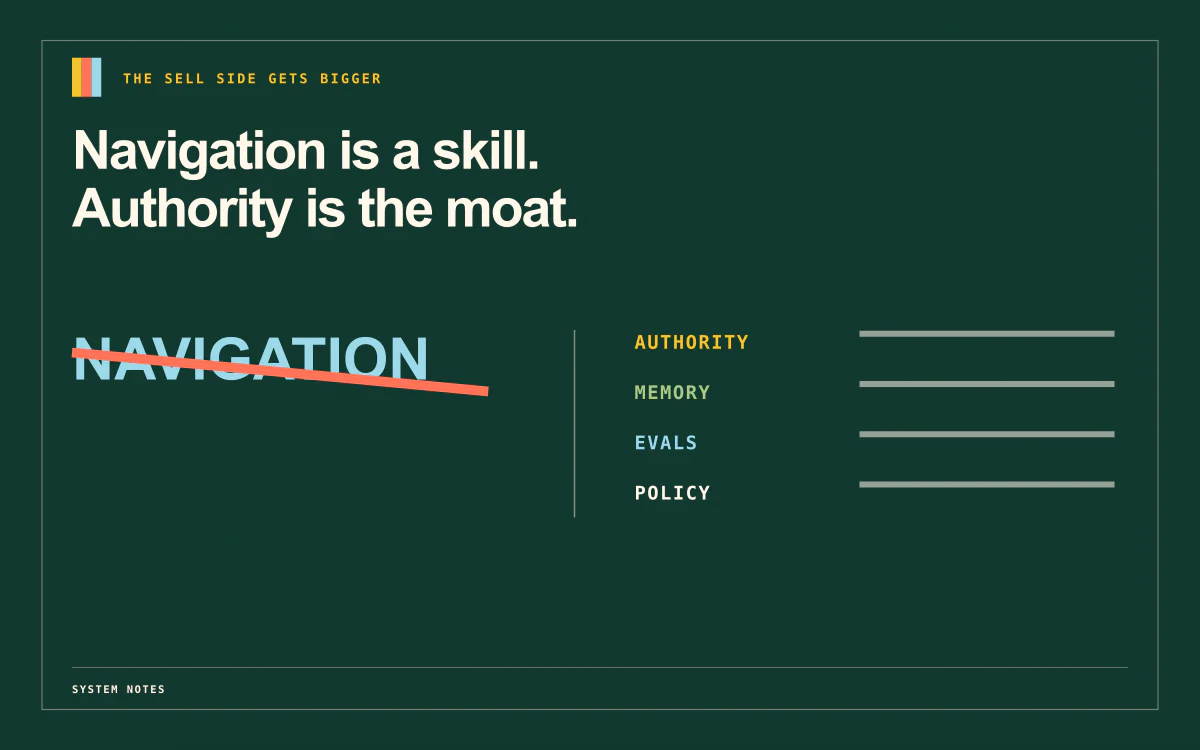
In late 2025, OpenAI put checkout inside ChatGPT with the world's largest retailer. It converted at roughly a third of walmart.com's rate. Shipping estimates were wrong, inventory was stale, and nothing remitted sales tax.
The fix wasn't a better model. Walmart put its own agent, Sparky, inside ChatGPT — running on Walmart's accounts, inventory, and checkout. In Walmart's own app, Sparky shoppers spend 35% more per order — a number Walmart has repeated on two straight earnings calls. OpenAI retreated to discovery and now routes the transaction through the merchant.
The model could click the buttons fine. What failed wasn't navigation. It was everything navigation can't get you.
Authority is granted, not learned
Concede the whole capability argument. Assume models navigate any site perfectly, for nearly free.
A perfect outside agent still doesn't have the user's account. Or their loyalty state. Or a payment credential the merchant trusts. Or real inventory. Or the right to issue a refund — and someone to hold liable when it goes wrong.
None of that is learned. It's granted, by the seller, on the seller's side. Capability compounds on the buy side. Authority compounds on the sell side. Rover is built on the second axis.
We're not betting agents stay bad
The sharpest pushback we hear is that we're betting agents stay bad at navigation — and that the best-capitalized companies alive are racing to close exactly that gap.
We assume they close it. We're betting on what's left when they do: the seller's side of the counter. A buyer's agent works for the buyer — best price, fastest exit. It will never upsell, retain, protect margin, or own the relationship. Converting is the seller's job, and it shows up on the seller's P&L. So the better buyer agents get at comparing and leaving, the more every seller needs an agent that works for it. Armed buyers don't eliminate the sell side. They make it mandatory.
We've seen this before
Search engines got infinitely better at reading websites. That didn't kill the sell side of search — it created it: SEO, analytics, conversion optimization. Marketplaces aggregated demand, and Shopify was built to arm every merchant against them. Stripe armed sellers for online payments.
Every time demand got a new machine, the durable business was built for supply to meet it. Search getting smarter grew SEO. Agents getting smarter grow Rover.
The market is every website
"Only complex sites need this," the objection goes. But every site with a login, a checkout, an inventory, or a policy is complex in the way that matters — and that's nearly all of commerce and SaaS.
The buy side is creating that market itself. OpenAI's ACP and Google's UCP are formal requests that merchants expose structured surfaces — two commerce protocols, plus MCP, plus agent-identity rails like Visa's Trusted Agent Protocol and IETF Web Bot Auth. Walmart can staff a protocol team. Two hundred million other sites can't. Somebody has to adapt them all. One script tag.
The leak is already measurable: agent traffic rose 805% year-over-year last Black Friday while site conversion fell, and AI-referred buyers convert 42% higher when the site can actually serve them. Intent is arriving. Sites are leaking it. That delta is the business.
What we're building
Rover doesn't price on agents being bad. Even for a perfect agent, the sell-side path is 11× faster, 25× cheaper, authenticated, and warm — it remembers the site. Perfect drivers still take the highway. Buyers feel it too: 65% trust AI to compare prices, only 14% to place the order, and closing that gap takes confirmation, mandates, and receipts only the merchant can own.
So we're doubling down where the compounding is: agent authentication, account mapping, payments, receipts — the merchant-owned transaction layer behind the A2W protocol.
The part of the stack that better models erode, we never depended on. The part that better models need more of, we're building.
Rover is the sell-side agent for every website. One script tag: humans guided, AI callable. Get started.


