Field notes
The Rover blog
Research, benchmarks, and strong opinions on agents and the web. Product updates, integration guides, and deep dives on DOM-native agent architecture — the notes from building Rover.
Research
How Jev Chooses the Next Browser Action
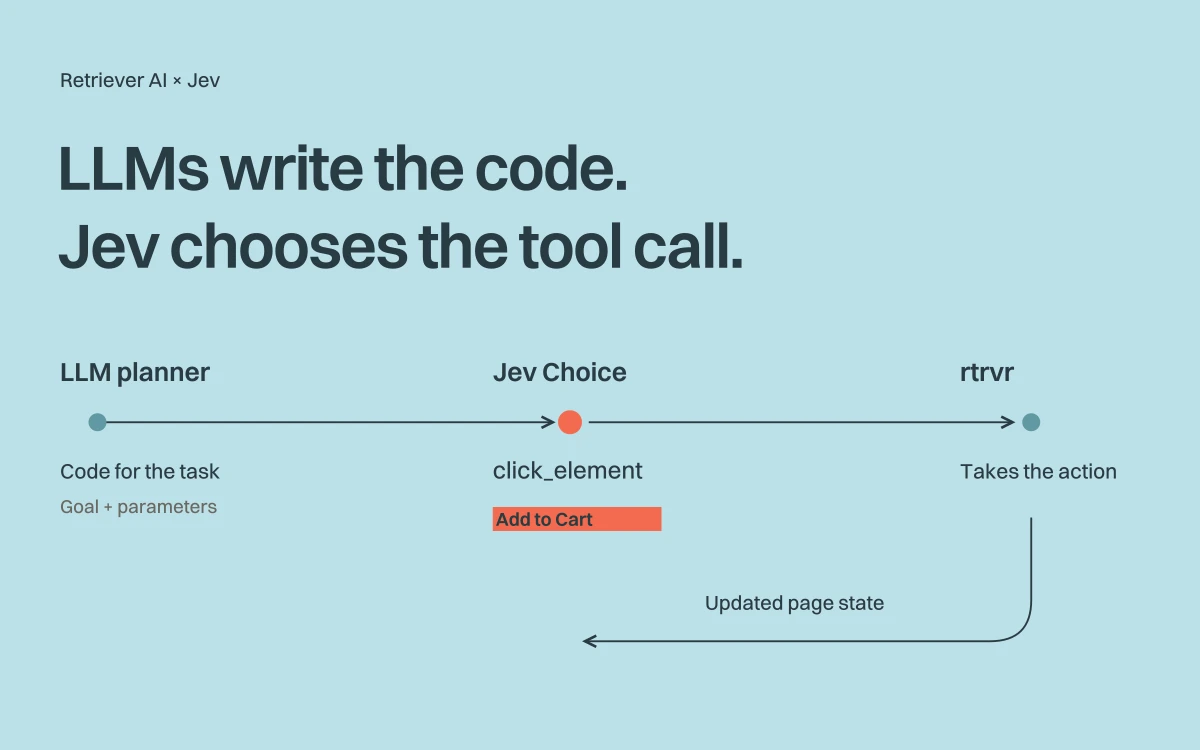
We added Jev to rtrvr’s browser agent to choose from the actions available on a page. Our LinkedIn and Amazon runs finished sooner, but scoring large pages raised the cost.
·Bhavani Kalisetty
Research
Stop Paying AI to Plan the Same Task Twice
In a new paper, a 9B model with tested skills beat a 27B model without them. Browser agents now need a way to find the right skill, test it, and remove it when it stops working.
·Bhavani Kalisetty
Research
Financial Markets and Model Routers
Stock markets aggregate information for price discovery. Blockchains distribute execution and settlement. Model routing can combine both architectures: centralized data for selection, local provider estimates, and independent verification of task completion before updating the next route.
·Bhavani Kalisetty
Personal design diary
The things I love found their way into Rover
A design diary about pink shoes, public art, tiny watches, stickers, split-flap boards, state machines, and learning to direct AI without letting it flatten my taste.
·Bhavani Kalisetty
Research
150 open roles. 125 job titles. One missing employee.
A public study of 150 active customer engineering roles across 53 companies. The titles fragment into 125 names; the work converges on one execution system no title owns.
·Bhavani Kalisetty
Research
Read the work, not the face: what an AI customer engineer should watch in a live call
When AI joins a live customer call it should read the shared work—screen, product state, logs, explicit commands—not guess emotion from a webcam.
·Bhavani Kalisetty
Thesis
The hive mind for your product
Pluribus is horrifying, and it is also the best customer service ever depicted. Nine weeks of first-party data on what a collective memory for a product can know, what it can do about it, and where the line is.
·rtrvr.ai Team
Thesis
Narration engineering: real-time speech for the AI sales engineer inside your product
Context engineering decides what a model reads. We had to engineer what an agent says out loud while it works — every spoken line is a claim about a screen that keeps changing.
·rtrvr.ai Team
Research
1 in 80 of our website interactions is already an AI agent
We put Rover on our own site and read the logs: 17,063 interactions: 213 from autonomous AI agents across 37 distinct tools. First-party data on what the agentic web actually looks like.
·rtrvr.ai Team
Guide
Navattic vs. Storylane: an honest comparison, and the live third option
The two leading interactive-demo platforms compared on price, fit, and editor, plus the one limit they share, and when a live product demo beats a click-through tour.
·rtrvr.ai Team
Thesis
Buy vs. build an in-product AI agent: a $100M arms race, or one script tag
Intercom has committed $100M+ and 60 AI researchers to keep one agent competitive. A minimum viable team costs $1.3–1.5M before it ships anything. The honest TCO of build vs. buy, and when building actually wins.
·rtrvr.ai Team
Analysis
Rover vs. Sierra & Decagon: deflection answers tickets. Operators finish them.
Sierra and Decagon resolve support tickets by answering. Rover resolves them by doing the task, and covers your marketing site with the same agent. The honest comparison.
·rtrvr.ai Team
Analysis
Rover vs. Navattic + Drift: one live surface, not two half-tools
96% of your visitors leave without booking a demo. A click-through tour can't answer their question and a chatbot can't show them anything. Here's the comparison, with numbers.
·rtrvr.ai Team
Thesis
Websites need headless agents, not chatbots
Browser agents are a compatibility layer. The durable interface is a site-side agent that exposes intent handoff, knowledge, auth, tools, payments, and policy.
·Arjun
Thesis
Navigation Was Never the Moat: Why Agents Make the Sell Side Bigger, Not Smaller
Models will soon navigate any website perfectly. That was never the moat. The agent that converts is the one the seller owns — its accounts, its payments, its data — and the world's biggest retailer just proved it inside ChatGPT.
·Arjun & Bhavani
Research
The Four Architectures for Website AI Agents
RAG bots can only talk. API-tool agents ship a second maintenance org. Code sandboxes burn per-user server cost. Only DOM-native execution inherits the web's own truth model — live HTML, user session, existing IAM. A structural comparison.
·rtrvr.ai Team
Analysis
Protocol vs. Prompt Injection: How Agent-Website Communication Should Actually Work
Mintlify injected hidden instructions into copied markdown to get agent feedback. Here's why the web needs declared protocols — not clipboard injection — and how Rover built the right architecture.
·rtrvr.ai Team
Research
The Agent-Web Protocol Stack: A Research Thesis
The web's protocol stack was designed for humans behind browsers. A new consumer is arriving: AI agents. This paper maps the emerging protocol landscape and positions Rover as the missing execution layer.
·rtrvr.ai Team
Agent Analytics for AI Agents
AI traffic is becoming real product traffic. Agent analytics gives Rover-enabled sites the missing observability layer: visits, runs, trajectories, AX scoring, feedback, memory, and experiment-aware analytics for agent traffic.
·rtrvr.ai Team
Guide
Turn Your Website into an AI Agent: Integration Guide
Step-by-step guide to adding Rover to your website. Script tag, npm, React, Vue — from setup to production in minutes.
·rtrvr.ai Team
Technical
DOM-Native vs. Screenshot Agents: Why Architecture Matters
A technical comparison of DOM-native and screenshot-based approaches to embedded web agents — speed, accuracy, cost, and security.
·rtrvr.ai Team