
 Add to Chrome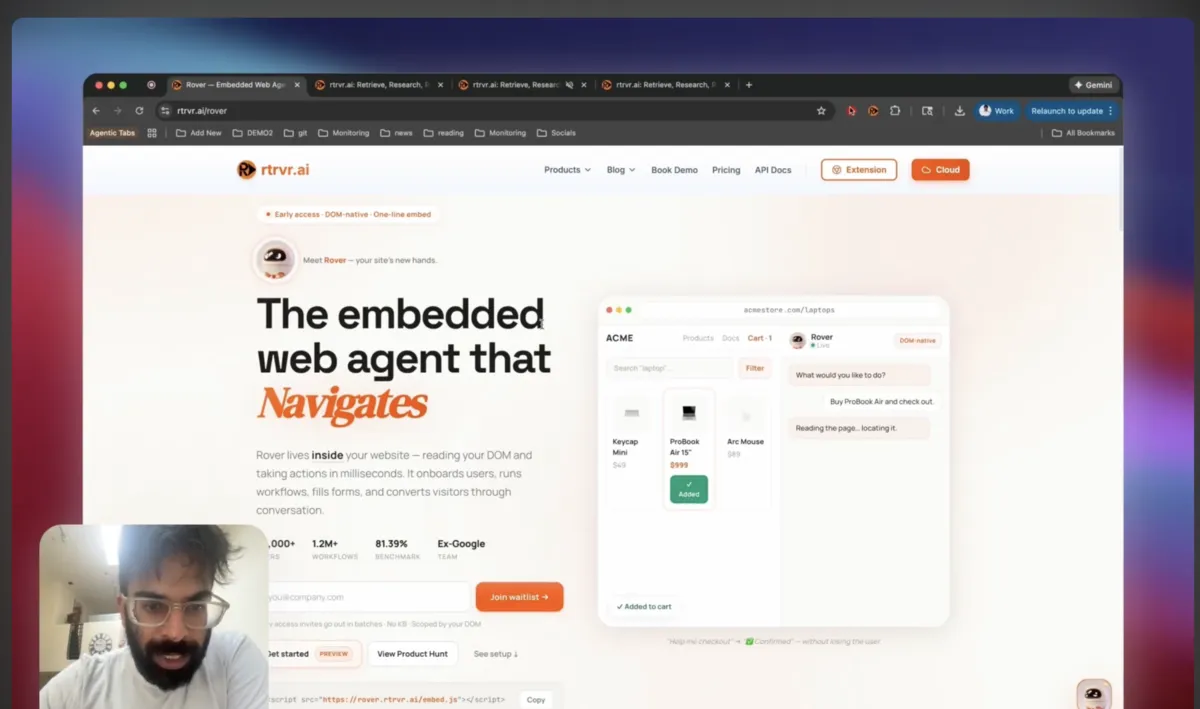
Embedded Agent Value Proof
Amazon's Rufus hit 250 million active users in under two years. Customers who use it are 60% more likely to finish a purchase. On Black Friday 2024, Rufus-assisted sessions converted at 3.5x the baseline.
That added up to roughly $12 billion in incremental sales for 2025.
So the question isn't whether conversational AI on websites works. Amazon settled that. The question is what the other 1 billion+ websites are supposed to do about it given that Rufus took thousands of engineers, decades of catalog data, and an estimated $285 million in operating costs before it turned profitable.
End User Use Cases
Beyond as a shopping assistant, a web agent on your site can conversationally:
- onboard users
- guide users through tricky workflows/features
- navigate and fill forms
- checkout and convert users
In the era of ChatGPT, users expect to have things done for them conversationally. If your website doesn't provide it, then they will shift to other interfaces that provide them with that experience either at the browser agent layer or as apps in ChatGPT.
What's actually available today
Build it yourself
RAG pipelines, custom code hooks, and integrations throughout your stack not to mention the continued maintenance to deliver a conversational agentic experience. This is what Amazon did. But this just isn't feasible for smaller businesses.
Intercom, Drift, and the support chatbot crowd
These are good at deflecting support tickets. Intercom's Fin cuts ticket volume by 50%, genuinely useful for support. But they can only either answer a question or call an API to your support system. They don't walk a user through checkout. They don't click buttons or fill forms. They don't demo your product. And you're still building RAG pipelines and piping API's under the hood and paying $0.99 per resolution.
Google's WebMCP
Google announced this two days ago. It's a protocol that asks websites to expose their internal APIs as structured tools so Chrome's AI agent can call them directly.
The pitch: make your site agent-ready and interactions get faster.
The reality: Google further disintermediates you from your users.
You do the integration work. You maintain per-page tool schemas synced to your internal APIs. You handle the auth flows. And Google's agent becomes the thing your user actually talks to, inside Chrome, not on your site.
We built the opposite
Rover started from a different question: what if you could drop a single script tag on your site and get an AI agent that actually does things for your users in your UI?
No RAG pipelines. No API exposure. No schema maintenance.
Rover reads the live DOM (your actual page structure, buttons, forms, nav, content) and understands it semantically. No screenshots. No vision models guessing at pixel coordinates. No knowledge base to keep updated.
What that looks like in practice
A user lands on your site and says "help me check out." Rover adds the item to cart, navigates to checkout, fills in their details, and confirms, all inside your UI. The user watches it happen on their screen.
Or a new user signs up and says "show me how to set up my first workflow." Rover opens the right panel, clicks through the integration flow, connects the data source, and walks them through each step.
It handles checkout flows, real-time onboarding, live product demos (actual walkthroughs, not videos), complex multi-step workflows, and form fills. Users ask, Rover does.
Why the DOM-native approach matters
Most AI web agents work one of two ways, and both have real problems.
Screenshot agents (Operator, Computer Use, etc.) take a picture of your site and use vision models to figure out where to click. They're slow, inaccurate and most importantly can't be embedded on your site as there is no way to get screenshots from an embed script.
API-dependent approaches (WebMCP, custom integrations) need you to expose every possible action as a structured tool. You build it, you maintain it, forever.
Rover uses custom Agent Accessibility Trees to semantically understand the page and determine what actions to take. It knows that "Add to Cart" is a purchasing action, that the sidebar is navigation, that a modal is a form. It plans the shortest path and executes with native browser precision.
This is how we hit 81.4% on WebBench ahead of every screenshot-based approach we've tested against due to our unique DOM-only architecture.
Rover is live
We've spent two years building the DOM-native architecture and Smart DOM Trees underneath this. Rover is live now at rover.rtrvr.ai for you to embed an agent in your site.
On February 25th, we launch on Product Hunt with our first waitlist companies.
If you want your own AI agent that works for your users instead of Google's, deploys in one line, and keeps your checkout, onboarding, and user relationships on your site:
rtrvr.ai is the DOM-native AI web agent platform. #1 on WebBench at 81.4%, 21,000+ users, 1.5M+ executed workflows.
Rover launches February 25, 2026 on Product Hunt.


