
 Add to Chrome
A creator’s biggest video is easy to find. The harder question is whether the rest of the account supports the story you are telling about it.
For a sponsorship shortlist or a content brief, start with a consistent sample. Keep the post links, dates, and visible metrics. Then ask what patterns the sample supports.
Watch the collection step
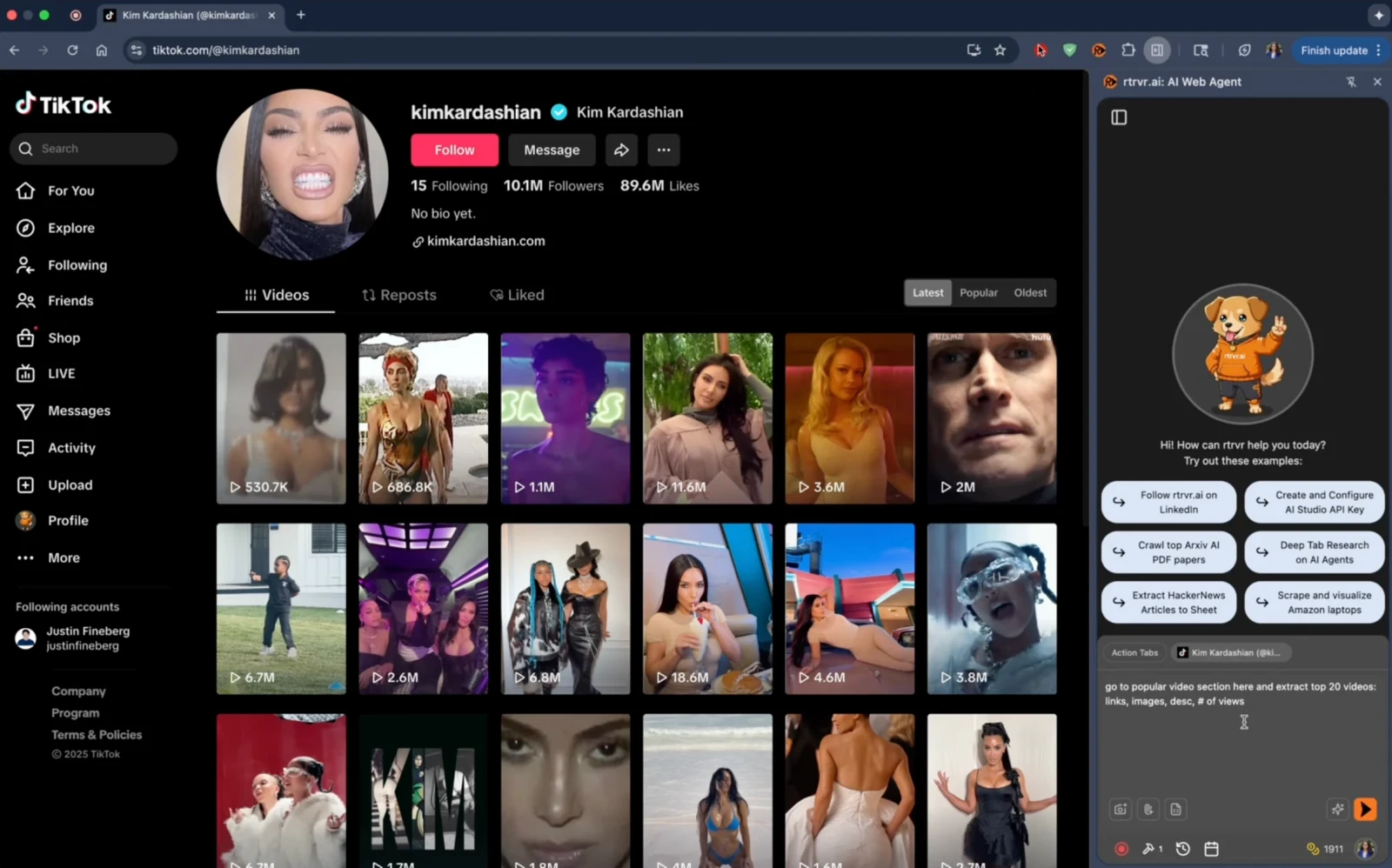
In this recording, we used Retriever AI to collect data from Kim Kardashian’s TikTok profile into a sheet. The August 2025 recording is evidence of that workflow at that time. Its title says “ANY,” but access, page changes, and missing fields can still limit a new run.
Collect TikTok video data.
Video links, captions, and views from Kim Kardashian’s profile. Recorded August 2, 2025.
Choose the question before the sample
For current account performance, choose the latest 12 non-pinned posts. For creative ideas, choose a clearly defined set of high-performing posts. Keep those samples separate: an account’s all-time hits do not describe what a typical new post achieves.
Start with one profile. Open it in your signed-in Chrome when the page needs your session. Cloud uses a separate browser; connecting an app elsewhere does not automatically sign that browser into TikTok.
Copy this collection prompt
Open this TikTok profile: [URL]. Collect the latest 12 non-pinned posts available to me. Return one row per video with the direct URL, caption, displayed publication date, displayed views, likes and comments where visible, pinned status, and time checked. Keep rounded counts as displayed. Mark unavailable fields as unknown and explain blocked posts. Do not like, follow, comment, or contact anyone. Give me a table and a CSV, then report how many of the 12 posts you could verify.
Download the blank collection template to set up your first sample.
| Field | What to preserve | Why it matters |
|---|---|---|
| Video URL | A direct link to the post | Lets a colleague check the row |
| Posted date | The displayed date and any uncertainty | Older posts have had longer to gather views |
| Views, likes, comments | The displayed value; unknown when absent | A missing value is not zero |
| Pinned status | Yes, no, or unknown | Pinned hits can distort a recent-post sample |
| Checked at | Time and timezone | Counts change after collection |
| Access note | What was blocked or unavailable | Explains incomplete coverage |
Check the table before asking for strategy
Open several source links, including the highest and lowest counts and at least one ordinary row. Confirm that the list contains distinct posts, that the dates match, and that rounded values such as “1.2M” were not presented as exact counts.
Use the median to describe a typical post in the sample; keep the mean and largest outlier alongside it. Neither is a prediction of what the next sponsored post will earn.
If you calculate an interaction ratio, name the numerator and denominator. For example, “visible likes plus comments divided by displayed views.” Leave it unknown if a required field is missing. Do not compare a comments-only ratio with someone else’s all-interaction benchmark.
Turn observations into a brief
Using only the checked rows, group the posts by subject, opening hook, format, sound, and collaboration where the source lets you verify those fields. Give me three patterns with supporting post URLs and three content ideas to test. Label interpretation separately from collected facts. Do not infer audience demographics, watch time, retention, saves, or purchase intent from public view counts.
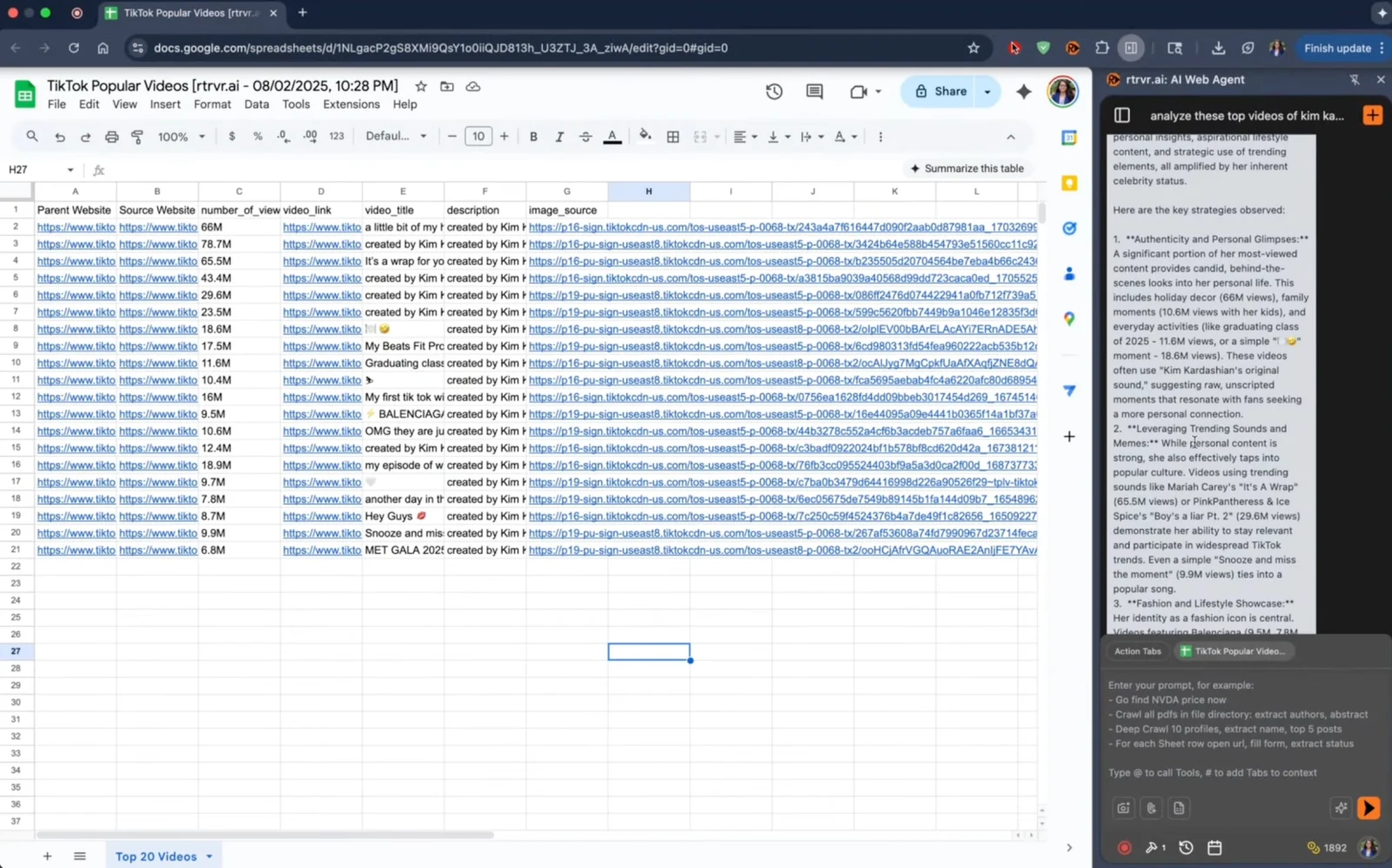
Our second recording shows this analysis step. It discusses sound, personal posts, collaborations, and fashion content. Treat those as interpretations of the sample, not proof that a particular tactic caused the views.
Analyze the TikTok posts.
Turn the collected posts into ideas to test. Recorded August 2, 2025.
A useful brief gives the team a choice: a pattern worth testing, the posts behind it, and the result you will measure on your own account. It does not promise another creator’s reach.
Extend the research
Use the Instagram creator workflow for a shortlist and draft replies. For another platform, try the YouTube competitor-analysis guide. Our Muse comparison shows why the difference between an unavailable metric and an unchecked page matters.
Free Mode includes supported AI models and Cloud browser time for tasks you start in the extension or Cloud dashboard. No AI API key or paid AI subscription is required. Sponsored cards and a daily fair-use allowance apply. A recurring schedule requires a paid plan. Review current plans and data terms.
Open Retriever AI in Chrome and try one profile before expanding the list.


