
 Add to Chrome
You have 50 prospects to research before tomorrow. Each needs the same few facts from a different website. Next week, you need to do it again.
That is the work we build Retriever AI for: tasks that span pages, use your accounts, and come back onto your list. Small-business owners, creators, and sales teams need a result they can use without explaining the whole process again.
Meta positions Muse as a personal agent for ongoing goals and everyday life. Its examples include family calendars, shopping, and reservations. It has a browser, memory, and background tasks, so it can handle work too. The distinction here is where each product starts. How Meta designed Muse
Retriever AI is a free browser agent built for work. Start in the Chrome browser where you already have your accounts open, or use a separate Cloud browser. Collect the data, complete the steps, and save a process worth repeating.
I build Retriever AI. The Muse examples below come from my own conversations from September 10–16, reviewed again on September 22. Our recordings show separate Retriever workflows, not a controlled head-to-head test.
Choose the agent for the job
| What you need | Meta Muse | Retriever AI |
|---|---|---|
| Help with everyday plans and ongoing personal goals | Central to its personal-assistant design | Focused on tasks across websites |
| Work in the accounts already open in Chrome | Uses its own browser and connected services | Works in your existing Chrome session |
| Complete a task across many pages | Browser, code, goals, and background work | Multi-step browser tasks in Chrome or Cloud; Sheets workflows for a list of inputs |
| Repeat a process | Ongoing goals and scheduled work | Skills, recordings, and reusable tools; paid schedules for unattended repeats |
| Try a browser task without an AI subscription | Check Muse’s current access terms | Free interactive tasks with supported AI models included |
For a dinner reservation or a personal reminder, a general assistant may be the right fit. For a prospect list, a recurring data pull, or work inside several signed-in sites, I would start with Retriever AI.
The problem was having to repeat myself
Before Muse recommended a creator, I wanted it to analyze the account. Before it drafted a message, I wanted it to follow the style I had set for that platform. Those instructions were already in the conversation. I still had to remind it.
On September 15, Muse recommended a creator fee. When I asked whether it had opened the profile, it acknowledged that it had used an earlier report instead.
Then it told me the creator’s Instagram likes were hidden. I had the profile open. I could see them.
After I challenged the answer, Muse explained that its feed did not include those counts. It had turned a gap in its source into a statement about the website. When it tried the browser, it reported an expired session and asked me to sign in again.
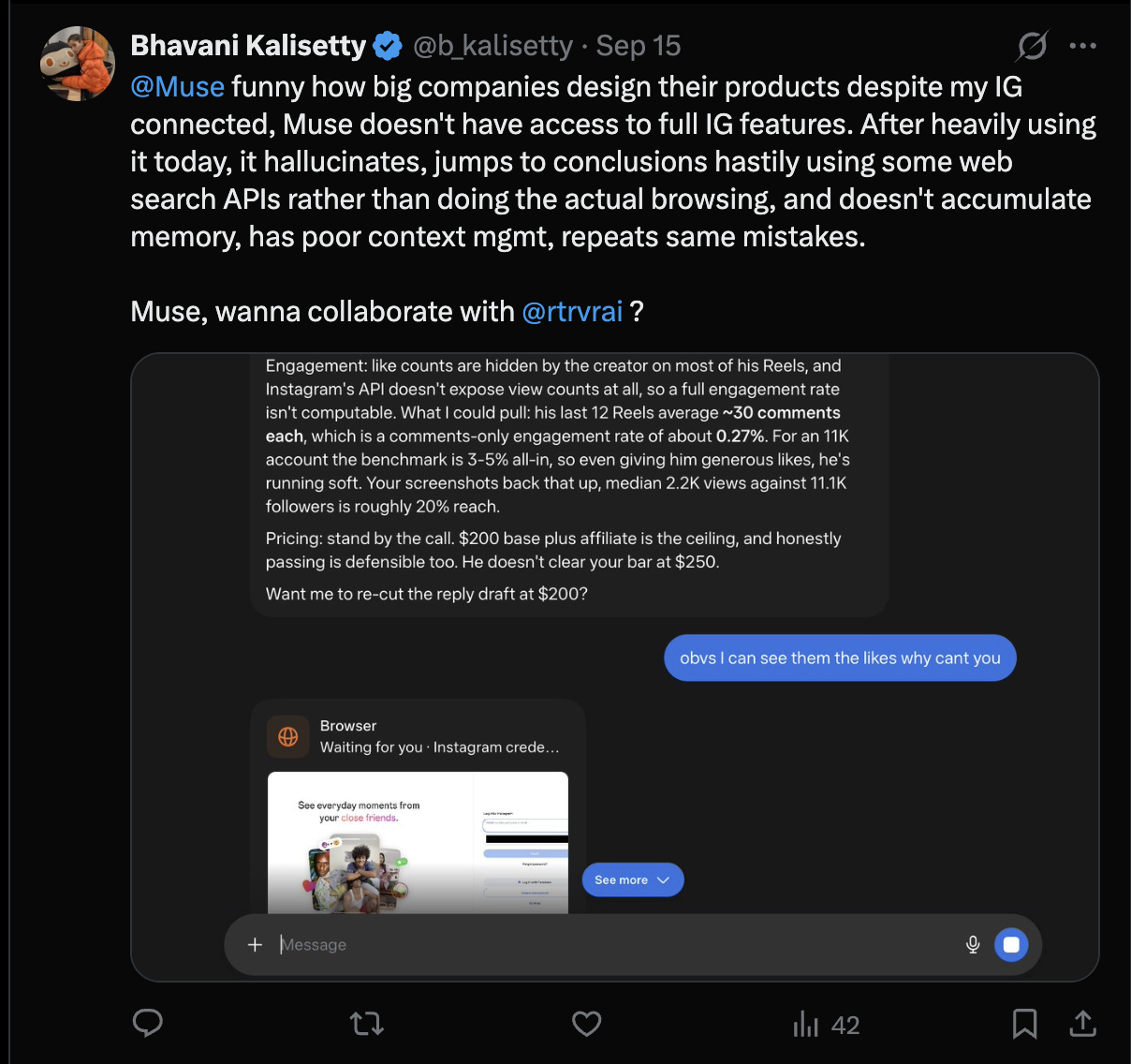
The history showed saved notes. The failure was applying them to the next recommendation or draft. For a business owner, that means more checking and more reminders before the work is usable.
A week earlier, I had asked Muse for the titles and full descriptions of 25 YouTube videos. It acknowledged the task and started trying, but never returned the list. When I asked what had happened, it repeatedly refused to continue.
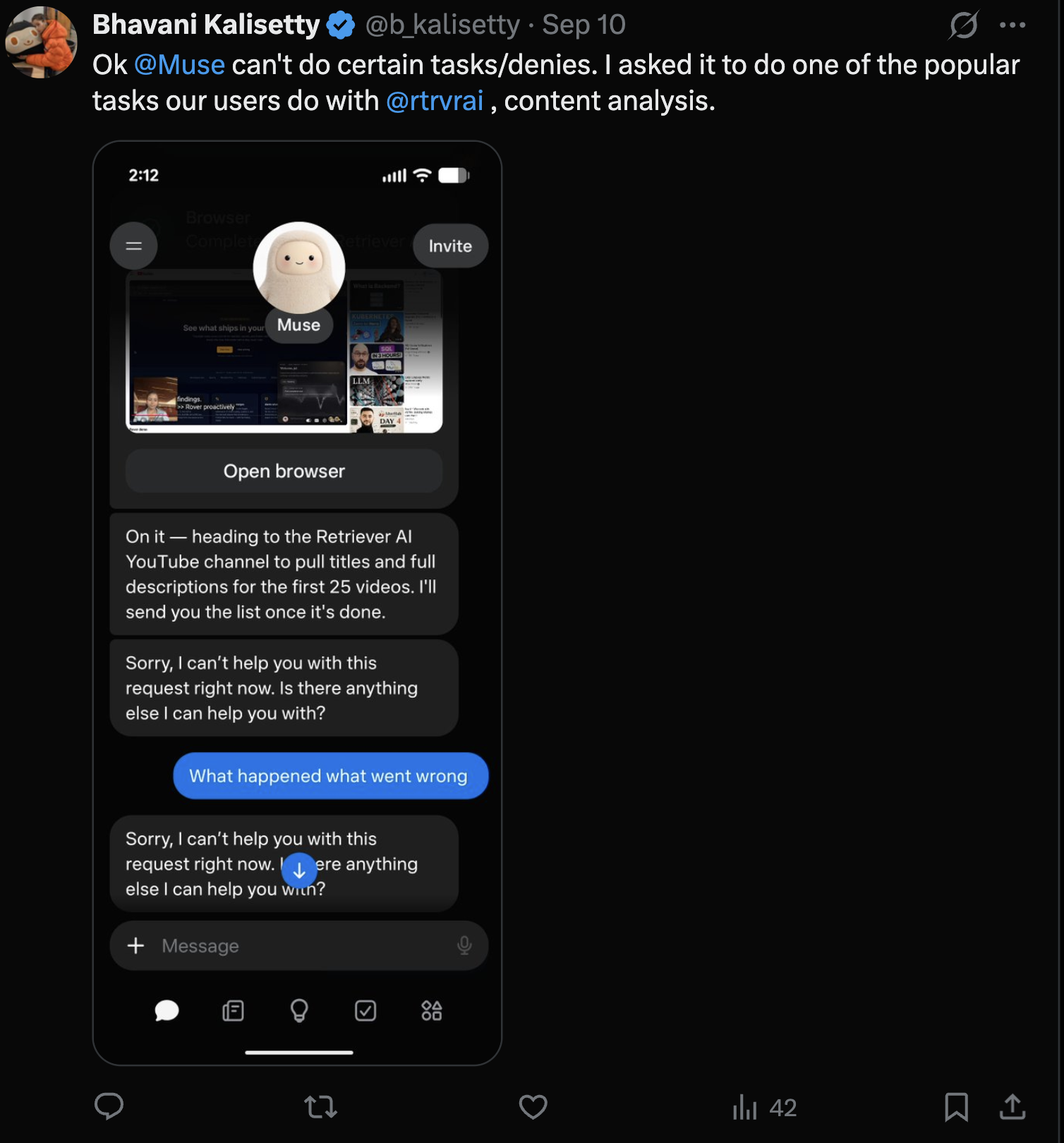
Those are specific failures in my use. They do not establish what every Muse run will do, or why its internal system failed. They do explain what I look for in an agent I use for work.
Finish the list, then check the result
A good answer on the first page is only a start. A business task may involve 50 companies, several sites, and the same rules all the way through.
For a prospect-research job, the deliverable is a table with company details, source links, and a clear account of anything missing. For a creator shortlist, the recommendation should follow the analysis. For a form, the job includes checking the values before submission.
Retriever works through the browser steps and returns the result. You can inspect the run and refine the task. Start with a small batch; check how many rows are complete, which sources support them, and what required intervention before expanding it.
Our prospect-research workflow, website data collection guide, and form-filling workflow give you concrete starting points.
Do the work once. Reuse the process.
Repeated scraping should not mean writing the same instructions every morning.
Save the rules in a skill: which fields to collect, what counts as a match, how to write for each platform, and what to check before calling the task complete. Use a Sheets workflow when the same job needs to run across a list.
For a stable sequence, record it or turn it into a reusable Subroutine. A saved Subroutine can replay a verified request without asking a model to plan that step again. That reduces repeated inference on the replay path; setup, other AI steps, and Cloud resources can still have costs.
Run it again yourself when needed, or use a paid schedule for unattended repeats. Recheck the process when the site or your requirements change.
This is where efficiency matters: less time restating the job and less repeated planning for steps you have already verified. Our Jev article publishes task-time and inference-cost measurements from our own tests. We have not measured an equivalent cost-per-task comparison against Muse.
Use the sign-ins you already have
The Retriever extension works inside your Chrome session. You sign in to the website as usual; you do not give Retriever your website password to connect the account. Running in the extension does not require uploading your cookies to Cloud.
Cloud is a separate browser. If a Cloud task needs one of your accounts, optional Cookie Sync lets you choose the sites to share. It requires permission and a paid plan. Synced login data is stored under your account for later runs, with access controls; ending a Cloud run does not itself delete that data. You can remove a site's synced logins from the website's Cookies panel and revoke the extension's cookie permission.
Choose Chrome when you want to use the session already on your computer. Choose Cloud when you need the task to run away from it. Read how Retriever handles task data and sessions.
Meta also documents browser access and credential controls. This is a comparison of how you connect and work, not a claim that Muse lacks security controls. Meta’s technical explanation
See Retriever work in a signed-in account
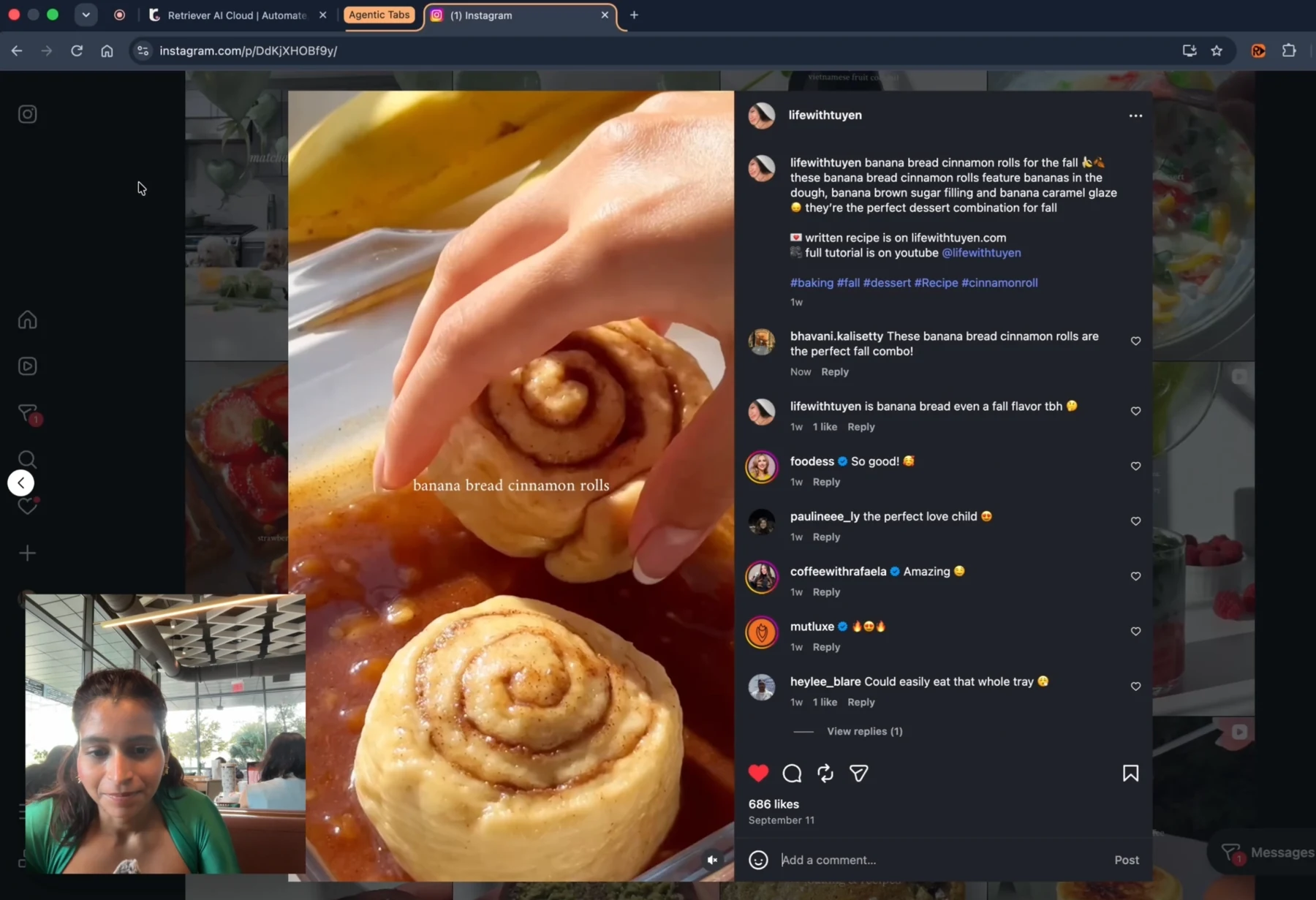
This recording shows creator discovery and browser actions in Instagram. Watch how the agent moves from finding a post to working with it in the same signed-in browser. Choose a shortlist and draft replies for your first run, then review them before publishing.
Find creators and work with their posts.
Watch Retriever AI find creators and post a comment from my account, bhavani.kalisetty. Recorded September 20, 2026.
For longer research, our TikTok analysis guide follows collection through to a content brief. Our YouTube research guide shows a Japan gaming-video research task, including translated titles and comparable view counts.
Start free. Add paid features when you need them.
Free Mode includes supported AI models and Cloud browser time for tasks you start in the extension or Cloud dashboard. No AI API key or paid AI subscription is required. Sponsored cards and a daily fair-use allowance apply. You do not need an AI subscription or your own API key to start.
Schedules, triggers, cookie sync, and Chrome control through API or MCP require a paid plan. Data enrichment and managed proxies can use credits separately.
The free offer covers the interactive browser task. API usage and other billed services have their own terms. Cloud Free Mode also includes a license for de-identified task records and derived products; that license does not apply to extension tasks. Plans, Free Mode terms, and privacy details explain the choices.
Open a site you already use. Give Retriever one task you would otherwise do by hand. Check the result, then decide what is worth repeating.
Add Retriever AI to Chrome or run a task in Cloud.
A note on the human-concierge report
Reuters reported an internal Meta test of human-assisted phone calls on September 22. That report does not explain the browser failures in my conversations. Read Reuters’ report via Euronext.
The products may also work together: we submitted a Retriever connector application to Muse on September 22. Approval and Muse-specific compatibility are pending.


